Key Takeaways
Salons, spas and skin-care centers rarely fail to afford a plasma device — they fail to understand what it costs to keep one busy. The purchase price is a one-time line item. The number that decides whether the machine actually pays back is the cost to deliver one session: what you spend per client versus what you charge. Cold plasma is unusual in how small that number is, which is exactly why it fits so cleanly into a course-based menu of 4–6 sessions.

Strip a plasma service down to its inputs and you get a short list. There is no expensive chemistry, no single-use cartridge system with a captive supply, and — for cold plasma specifically — no consumable gas in most configurations.

Because the disposable is the only cost that grows with your client count, it is worth pricing carefully. Typical ranges salons see:
| Consumable | Replaced | Typical unit cost impact |
|---|---|---|
| Single-use plasma tip / head | Per client (or per course stage) | Low, single-digit per session |
| Cleaning / disinfection kit | Shared across many sessions | Negligible per session |
| Replacement work head | Wear-based, months of use | Spread across hundreds of sessions |
| Cables & accessories | On demand | Rare, manufacturer-priced |
For ozone or jet-style configurations the math is similar, with the addition of a gas source that is itself inexpensive and long-lasting. Honkay quotes exact consumable pricing per market, so the figure above should be confirmed against your regional quote rather than treated as a fixed number.
Cold plasma consoles draw a fraction of the power of a laser or RF platform. Over a full day of back-to-back sessions the electricity cost is typically less than one disposable tip. There is no special facility requirement, no coolant loop, and no ventilation upgrade — which keeps the total cost of ownership low for a single-chair studio as easily as for a multi-room chain.
Most "maintenance" is preventive and cheap. The device body needs only routine exterior cleaning; the work heads need correct storage and periodic replacement; and software-driven consoles rarely need on-site service. The bigger lever is warranty and parts availability: a manufacturer that ships spare heads and cables quickly avoids the silent-cost scenario where a $20 part takes a machine offline for weeks.

The cleanest way to model profitability is to split the device cost across the sessions it will deliver, then add the disposable. A stylized example:
| Cost component | Assumption | Per-session share |
|---|---|---|
| Equipment amortization | Device spread over ~600 sessions | Small, fixed |
| Single-use tip | One per client | Low, per session |
| Electricity & facility | Low-power console | Negligible |
| Operator time | 10–20 min add-on | Already in your labor model |
| Typical service price | Course-based add-on | Several times the cost |
The gap between that per-session cost and the price you charge is the gross margin that funds the machine and then compounds. Because the cost side barely moves while the price side is set by the value of the service, plasma stays profitable long after the device is paid off.


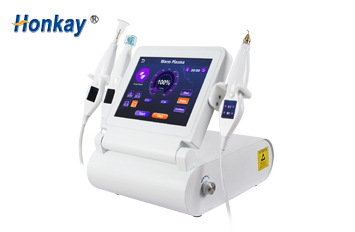
Multi-head console that amortizes across facial, scalp and precision menus — the lowest cost-per-session chassis Honkay offers.
View product →
Patented gourd handle and hot & cold modes from one device — ideal for studios that want one machine to do everything.
View product →
Factory-direct pricing with full documentation and spare-part support — protects total cost of ownership for chains.
View product →
Nine functions in one handle for glow, texture and calming — a compact, low-overhead entry device.
View product →What is the main running cost of a cold plasma device?
The single-use tip or head — it is the only consumable that scales with your booking count. Everything else (power, facility, maintenance) is essentially fixed.
Does cold plasma need expensive gas or chemicals?
Most cold plasma configurations do not. Ozone or jet-style models add an inexpensive, long-lasting gas source, but there is no captive single-use cartridge system.
How is cost per treatment usually calculated?
Spread the device price across the sessions it will deliver, add one disposable tip per client, then compare that total to your service price. The margin is typically large.
What protects margin for a chain or distributor?
Total cost of ownership: warranty length, spare-part availability, training and factory-direct pricing matter more than the headline unit price.
Will maintenance take the machine offline often?
No — it is mostly preventive cleaning and head replacement. Keeping spares on the shelf avoids downtime entirely.
Cold plasma is one of the lowest-overhead devices a salon can add: a small per-client disposable, negligible power, and preventive maintenance are the entire running cost. Priced as a course-based add-on, the per-session cost is a fraction of the service fee, which means the machine pays for itself quickly and keeps earning long after. Buy factory-direct, standardize on one multi-head platform, and let the consumable — not the device — be the only cost that grows with your success.
Honkay is a beauty-equipment manufacturer specializing in plasma devices for salons, spas, skin-care centers and distributors — with factory-direct pricing, OEM/ODM branding, CE/EMC/ROHS/LVD documentation, online training with every unit and a written warranty. Tell our team your target country and monthly booking estimate, and we will model the consumable cost and spare-part plan for your market.


 English
 中文